1932 — 2019 · Astrophysicist
Nikolai
Kardashev
The Soviet astrophysicist who dared to imagine civilizations measured not by borders or wealth, but by the raw energy of worlds, stars, and galaxies they command.
The Man
A life spent listening to the cosmos
Nikolai Kardashev belonged to a rare breed of scientist — equally at home with rigorous radio astronomy and with the most expansive questions about our place in the universe. He helped found the modern search for extraterrestrial intelligence and spent his career building instruments to hear the faintest whispers of the sky.
His genius was to make the unimaginable measurable. By framing civilization as a question of energy, he gave science fiction a ruler and gave science a new horizon.
- 1932
Born in Moscow
Nikolai Semyonovich Kardashev is born on 25 April in Moscow, Soviet Union, into an era on the cusp of the space age.
- 1960
Doctorate under Shklovsky
Completes his graduate work at the Sternberg Astronomical Institute, mentored by the legendary astrophysicist Iosif Shklovsky.
- 1964
The Kardashev Scale
Publishes "Transmission of Information by Extraterrestrial Civilizations", proposing a way to classify civilizations by their energy consumption.
- 1970s–2000s
Radio astronomy pioneer
Drives Soviet and Russian deep-space radio astronomy, championing space-based interferometry to see the universe in unprecedented detail.
- 2011
RadioAstron launched
His decades-long vision becomes reality as the Spektr-R space radio telescope launches, forming an interferometer larger than the Earth.
- 2019
A lasting legacy
Kardashev passes away on 3 August, leaving behind a framework that still shapes how humanity imagines its cosmic future.
The Theory · 1964
The Kardashev Scale
A method of measuring a civilization’s level of technological advancement based on the amount of energy it is able to use. The more energy a civilization commands, the more it can shape the universe around it.
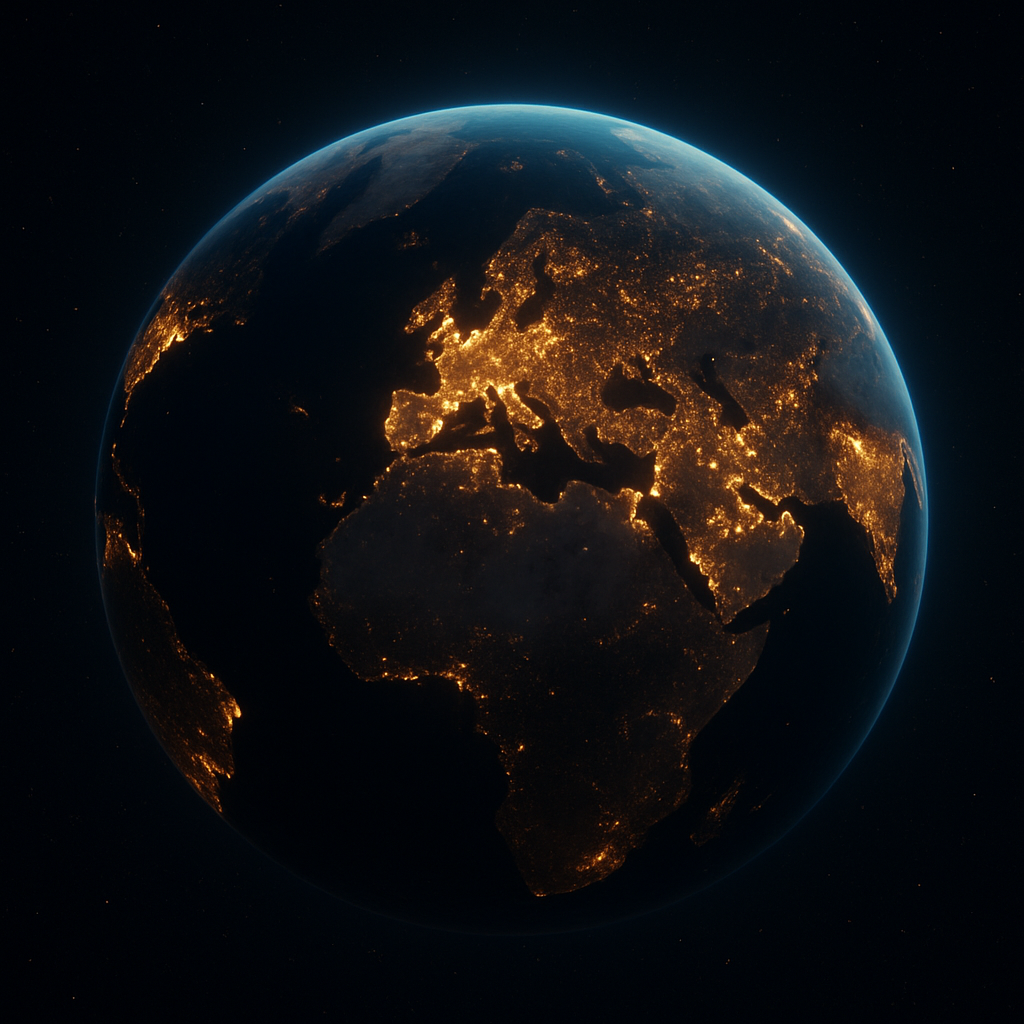
Master of a world
Planetary Civilization
A Type I civilization harnesses all the energy available on its home planet — the total sunlight reaching it, plus the power locked in winds, tides, oceans, and the planet’s own geology. Humanity is not there yet; estimates place us around Type 0.7 on the continuous scale.
- Captures all incident stellar energy on the planet
- Controls planetary-scale phenomena like weather and climate
- Energy budget thousands of times larger than today’s humanity
Kardashev defined the scale continuously, so a civilization’s type can be calculated from its power in watts. Later thinkers proposed hypothetical Type IV (universal) and Type V (multiversal) extensions — but the original three remain his enduring contribution.
Where Are We Now?
Humanity on the Kardashev Scale
Kardashev defined his scale continuously, so any civilization can be placed on it from the energy it commands. Drag the slider to journey from where we stand today all the way to a galaxy-spanning future.
Kardashev Rating
Energy Commanded
2.0 × 10¹³ W
Humanity, today
We currently harness only a fraction of the sunlight, wind, and geological energy of our own planet. We are a fledgling Type 0.7 civilization.
Beyond the Scale
A working scientist, not only a dreamer
The Kardashev Scale may be his most famous idea, but it grew from a lifetime of rigorous, hands-on astronomy. He built the instruments that let us actually listen to the universe.
Founding SETI thought
His 1964 classification became a cornerstone of the search for extraterrestrial intelligence, giving researchers a concrete framework for what advanced civilizations might look like — and how their energy use might betray their presence.
Space radio astronomy
Kardashev was a tireless advocate for placing radio telescopes in space, enabling interferometers far larger than any possible on Earth and resolving the universe in extraordinary detail.
The RadioAstron mission
He was the science lead behind RadioAstron (Spektr-R), a space-based radio telescope that worked with ground stations to form a virtual telescope larger than the Earth itself — among the highest-resolution instruments ever built.
Mentorship & institutions
As a leader at the Astro Space Center of the Lebedev Physical Institute, he shaped generations of astrophysicists and helped steer Soviet and Russian astronomy for decades.
Legacy
“The question is not whether other civilizations exist — it is how much of the universe they have learned to wield.”
In the spirit of Nikolai Kardashev
More than half a century after he proposed it, the Kardashev Scale remains a fixture of astrophysics, futurism, and popular imagination. It reminds us that progress can be measured outward — toward the stars — and that humanity’s story may only just be beginning.